 Fermento


 App of the Day
from the creators of
 murmur
 Layered
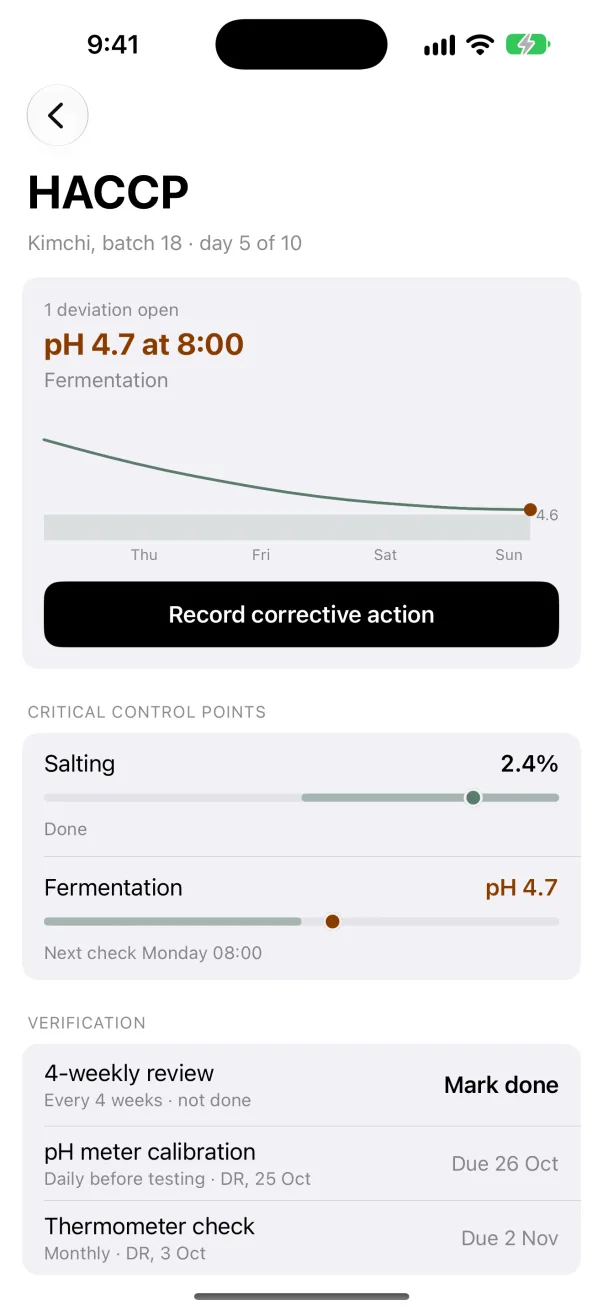
A HACCP plan is a short document with a fixed shape. It lists what could make the food unsafe, the steps where you control it, the number you hold each step to, and the record that proves you did. The shape comes from the seven HACCP principles in the Codex Alimentarius, and food law in the European Union, the United Kingdom and the United States builds on them.
Before the seven parts, a plan describes the product and walks through the process step by step. Then it answers seven questions.
The seven parts
| Part | Kombucha | Kimchi and sauerkraut |
|---|---|---|
| 1. Hazards | Pathogens can grow before the brew turns acidic | Listeria, E. coli and Salmonella arrive on raw produce |
| 2. Critical control points | Culturing, fermentation, bottling | Salting, fermentation, packing |
| 3. Critical limits | pH 4.2 or lower within 7 days (United States) | More than 2% salt, pH below 4.6 within a week (United States) |
| 4. Monitoring | pH checked daily near the end | Salt weighed on a calibrated scale, pH on set days |
| 5. Corrective actions | Keep fermenting and retest | Add salt before fermenting, or keep fermenting and retest |
| 6. Verification | pH meter calibrated before testing | Thermometer checked, log reviewed on a schedule |
| 7. Records | A monitoring log for each batch | A monitoring log for each batch |
The example lines come from Fermento's plan templates. The limits change with where you sell, and each template names the guidance it uses.
The parts people leave out
Corrective actions. A plan has to say what happens when a reading is out, before it happens. Hold the batch, retest it, discard it or release it, and write down which.
Verification. A pH reading means little if the meter was never calibrated. The plan lists the checks on your own checks, with a date and a name against each.
Records. The log is the proof that the plan was followed. Each line needs the date and time, the check, the reading, the limit, who took it and what was done if it was out.
See a full example
- HACCP plan for kombucha, step by step, with limits for the United States and the United Kingdom.
- HACCP plan for kimchi and sauerkraut, with the same detail.
- Log sheets to print: a blank monitoring log and a corrective action record.
In Fermento
Fermento starts a plan from a template for your product and the rules where you sell. It compares each reading with its limit as you type, opens a deviation when one is out, and exports the log as a PDF. See HACCP in Fermento.
A template is a starting point. Your regulator decides what your plan must contain, so take it to them before you rely on it.
Updated 11 November 2026.
Questions
What are the seven principles of HACCP?
Analyse the hazards, find the critical control points, set a critical limit for each, monitor them, decide the corrective actions, verify that the system works, and keep records.
What is a critical control point in fermentation?
A step where a measurement keeps the food safe. In Fermento's templates, kombucha has three: culturing, fermentation and bottling. Kimchi and sauerkraut have three: salting, fermentation and packing.
Do I need a HACCP plan to sell kombucha or kimchi?
That is your regulator's decision, and it differs by place and by how you sell. Ask them first, and bring a written plan with limits and records to that conversation.