
HACCP plan example

HACCP plan for kimchi and sauerkraut

The steps, hazards and critical limits in a plan for fermented vegetables, as Fermento's template sets them up for the United States and the United Kingdom.

Download Fermento on the App Store AppleApp of the Day from the creators of murmur and Layered

HACCP plans are part
of a paid plan.

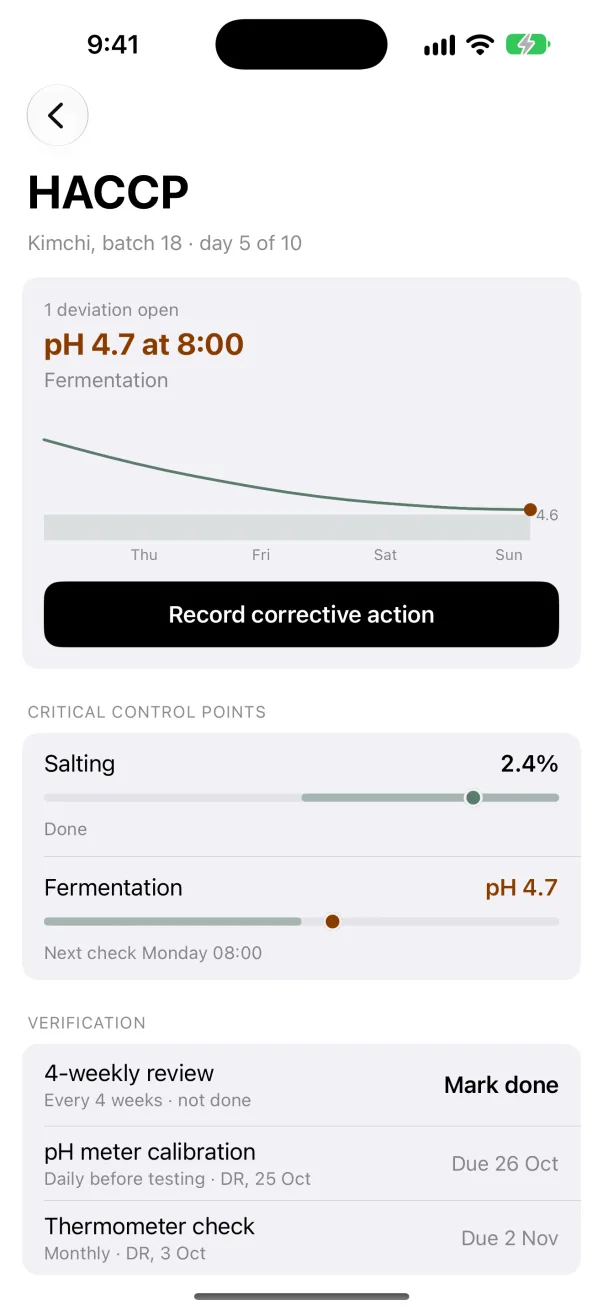
The HACCP view for a kimchi batch: one deviation open at pH 4.7, the pH curve against its 4.6 limit, control points for salting and fermentation, and verification tasks such as pH meter calibration
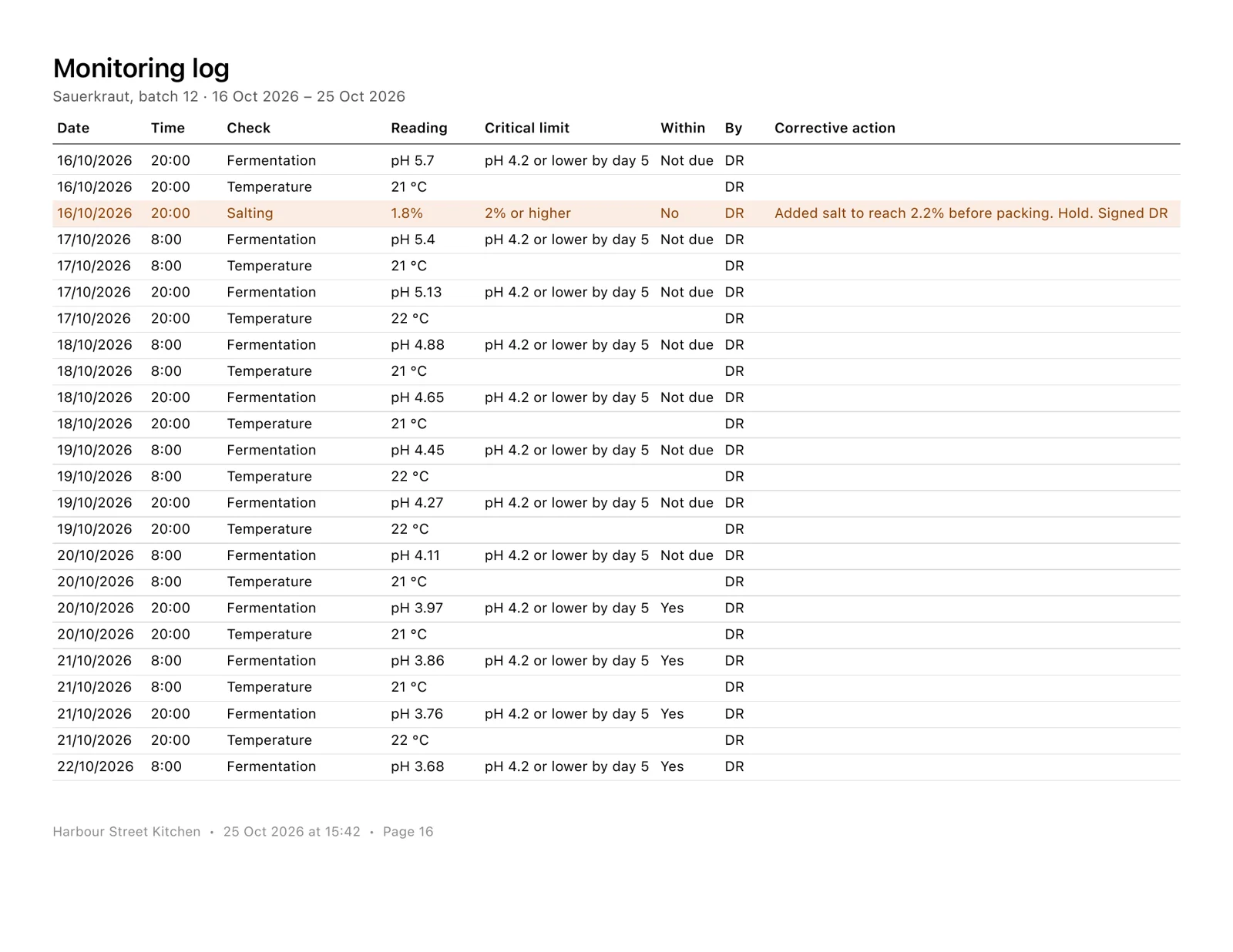
A monitoring log exported from Fermento as a PDF for a batch of sauerkraut: date, time, check, reading, critical limit, whether it was within the limit, who took it and the corrective action

The plan

What the plan contains

A plan for sauerkraut, kimchi or brined vegetables rests on two measurements: enough salt at the start, and a pH that falls far enough, fast enough. A third check stops anything being packed before it has passed. This is how Fermento's template writes them down.

1

Receiving and preparation

Step
Hazard
Listeria, E. coli and Salmonella on raw produce.
Limit
Wash produce in potable water. Salt within 1 hour of cutting, and start within 24 hours or refrigerate.
United States
Good practice step in the template.
United Kingdom
Good practice step in the template.
If it fails
Reject damaged produce. Refrigerate anything that cannot be started in time.
2

Salting or brining

Critical control point
Hazard
Too little salt lets spoilage organisms and pathogens outgrow the lactic bacteria.
Limit
A minimum salt percentage by weight, or a minimum brine strength, weighed on a calibrated scale.
United States
Snyder et al., Food Protection Trends 2020 (USDA ARS): above 2% salt, 2.0 to 2.5% for consistency.
United Kingdom
FSAI Guidance Note 37: sauerkraut 2 to 2.5%, kimchi 2 to 3%.
If it fails
Add salt or brine to reach the target before fermenting.
3

Fermentation

Critical control point
Hazard
The pH falls too slowly and pathogens survive.
Limit
pH at or under the set value by the set day, with the room kept in range.
United States
Snyder et al. 2020: below 4.6 within a week and falling steadily. Ferment at 15.6 to 24 °C.
United Kingdom
FSAI Guidance Note 37: kimchi 4.2 to 4.8 within 3 to 5 days, held at 4.6 or lower to the end of shelf life. Ferment at about 18 to 22 °C.
If it fails
Check salt and room temperature, keep fermenting and retest at the next check.
4

Packing

Critical control point
Hazard
Listeria can grow in unpasteurised product that has not acidified enough.
Limit
pH at or under the release value, measured for every lot before packing.
United States
Release value set by the template for the United States.
United Kingdom
Release value set by the template for the United Kingdom.
If it fails
Keep fermenting under control and retest.

This is the content of Fermento's template, with the guidance it cites. A template is a starting point. Your regulator decides what applies to your kitchen, so take the plan to them before you rely on it. Fermento is a record-keeping tool and does not give legal advice.

In the app

The limit is checked as you log

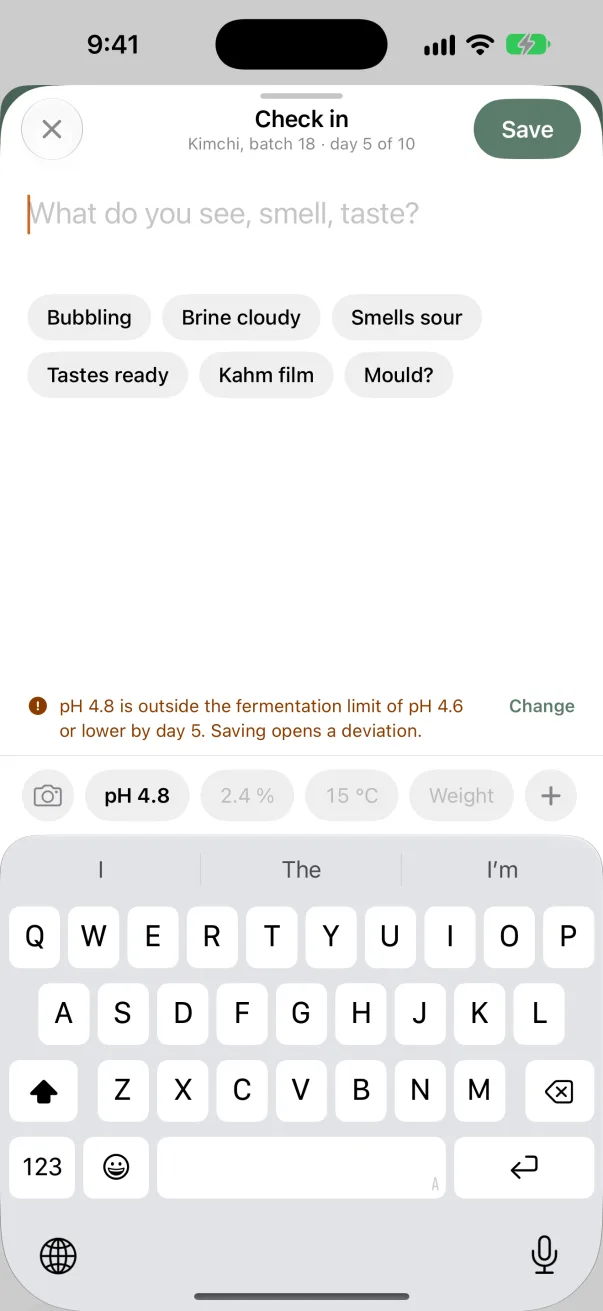
Type a reading and Fermento compares it with the critical limit for that step and that day. One that falls outside the limit says so before you save, and saving opens a deviation with a corrective action to record.

How HACCP works in Fermento

A check-in for a kimchi batch: typing pH 4.8 shows that it is outside the fermentation limit of pH 4.6 or lower by day 5, and that saving opens a deviation

The record

Every check ends up in the log

The PDF lists each check with its reading, the limit, whether it was within it, who took it and what was done about any deviation. That page is what an inspector asks to see.

Blank log sheets to print

The monitoring log page of the exported PDF, with one deviation highlighted and its corrective action written beside it

Questions

What are the critical control points for sauerkraut and kimchi?

In Fermento's template they are salting or brining (a minimum salt level), fermentation (pH at or under the limit by a set day) and packing (a release pH for every lot).

How much salt does a HACCP plan for sauerkraut require?

Fermento's template takes the minimum from the guidance for where you sell. For the United States it cites USDA research: above 2% salt by weight. For the United Kingdom it cites FSAI Guidance Note 37: 2 to 2.5% for sauerkraut and 2 to 3% for kimchi.

Do I need a HACCP plan to sell fermented vegetables?

That is your regulator's decision, and it differs by place and by how you sell. Ask them first. A written plan with limits and records is what you bring to that conversation.

HACCP plan for kombucha   HACCP in Fermento

The wait is worth it

Fermento is on the App Store, for iPhone and iPad.

Download Fermento on the App Store AppleApp of the Day from the creators of murmur and Layered